











 15 May 2014
  Posted by Bisiklet Gezgini
The myth of the American “Randonneur”
or: Why this is not a good touring bicycle
There was a time in the 1880’s –‘90’s when the craze for “Randoneés”, that is for covering a distance by bicycle in a specific time, initiated in France (Audax Club de Paris etc.), also reached the New World. It is hard to imagine it now, for such a car- and mountain bicycle oriented nation, but at that time this kind of cycling / racing was extremely popular, drawing huge crowds, participants as well as spectators, and being closely followed by newspapers – similar to what soccer is today one could say.[1]
It is only natural that the French influence on bicycle design and materials was immense, after all, this was the country that was in the forefront of technical expertise, at least as far as bicycles were concerned, on those days. Really, the bicycles coming at that time and up to the 1950’s from France were the most appropriate for this kind of cycling.
Since everyone cycling “seriously” would certainly own this kind of bicycle, it is not surprising that, when it came to touring, people would try to adapt them to carry their luggage on them.
That is exactly where the problem starts, for those bicycles were actually designed with a specific purpose in mind, lightness and speed that is, and were thus inherently less well suited to long-distance touring of the totally independent type, i.e. with a full load of tent, clothing, victuals etc.
They were still used for this purpose nevertheless, since the average utility bicycle of the day would sometimes weigh something in the region of 30kg and drive more or less like a tractor…
Now, the curious thing is that vestiges of this enormous influence of a French design philosophy and cycling culture of yesterday are still remaining and have evolved in the form of the SURLY brand of “touring” bicycles, as well as various exclusive, hand-made frames from small, independent manufacturers (or constructeurs[2] – to use the French word, of course…)
Being of the “Randonneur” style, i.e. light and fast frames, with drop-bars and (very) traditional, one could even say old-fashioned, derailleur gears (not even the HG system of SHIMANO is accepted by some purists…) and even sometimes running on hand-made, French-named (Grand Bois!…) tyres, they are machines beautiful to behold, but entirely unsuited to touring as we practice it: With up to 45- 50kg of luggage and on any road that is. Very nostalgic it may be, but it is not after all very clever trying to adapt 1930’s – ‘50’s technology to today’s standards and requirements, instead of accepting it’s being fundamentally unsuited for this kind of riding.
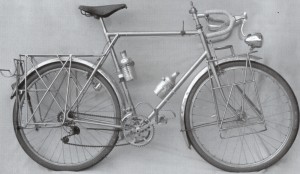

“Why is that so?”, you will ask. Well, here it is:
Frame:
- Geometry: Having been derived from what essentially was the geometry of 1930’s – ‘50’s French racing bicycles, from which after all they originate, this kind of “Randonneurs” with their drop-bars can only be used in a fairly forward-leaning riding position. This puts more strain on the wrists, arms, neck muscles and back. Unless you are a very fit, well-trained and “battle-hardened” cyclist, after a few hours riding in this position becomes very tiring and eventually instead of enjoying it, you end up suffering from various pains. Now, this was not the purpose of cycling, was it? That is why proper touring bicycles are generally designed for a more upright position.
- Lightweight, thin tubes that will not even resist to the pressure necessary to mount a kickstand. We have had several customers coming into our workshop with this kind of damage too on their frames. They were not happy at all to discover this, as you may well imagine…
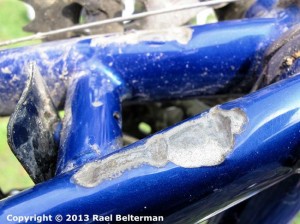
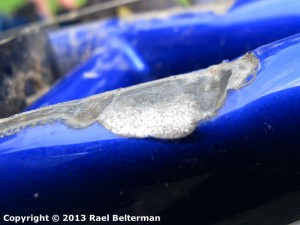
To counter this, people have been trying hideous solutions…
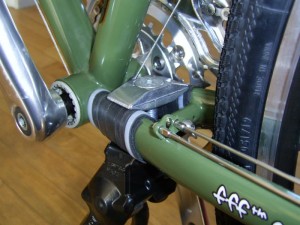
Compare this to the minimal but strong kickstand mounting on, say, a VSF Fahrradmanufaktur touring bicycle:

A rear kickstand is, by the way, the best solution for bicycles that are going to be loaded with luggage: Support is where the weight is and the bicycle will not roll over. This is not an option with the frames of SURLY and THORN, because of their extremely lightweight and thin tubes at the rear that will not support a rear kickstand…
A middle kickstand will also be a nuisance when you try to hand-roll you bicycle backwards to park or move it, as pedals will snag against it.
Those frames will also only with difficulty support a heavy load, especially on bad, unpaved roads: Because of the thin-walled tubes, the frame is not stiff enough by itself and it consequently becomes wobbly and difficult to control. To counter this, massive racks have to be used, with lots of fastenings and screws. These are so heavy as to eventually cancel out any weight saving in the construction of the frame and the multitude of protruding screws will damage your precious water-proof bags…
So, a stronger and yes, a bit heavier, frame right from the start, like for example in VSF or SANTOS, really is preferable after all, since it will not only be stiffer and better suited to carrying luggage on light, high-quality steel TUBUS racks, but also almost impervious to structural damage under hard use conditions.
Compare the complexity and, consequently, weight, of SURLY and TUBUS racks:

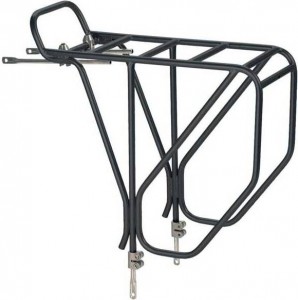
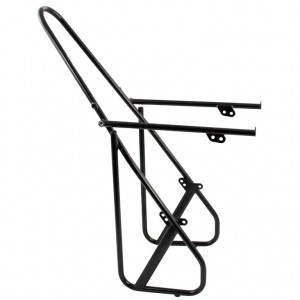
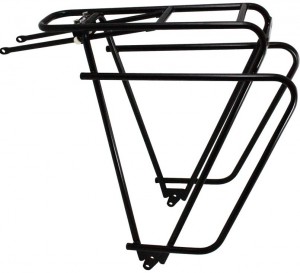
TUBUS Ergo front rack 554g TUBUS Logo rear rack 778g
We have also seen other kinds of basic structural failure on this kind of frames (and the owners were not happy at all!), that we never actually encounter on VSF Fahrradmanufaktur, SANTOS or KOGA touring steel frames.
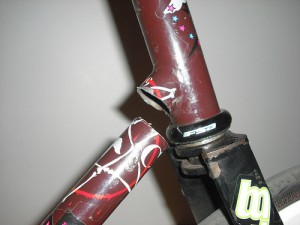
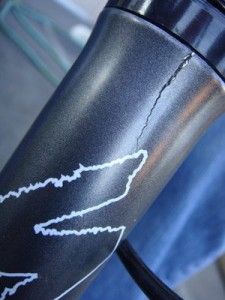
Fat tyres, as we use them to absorb vibrations and make the ride more stable and easier, are also impossible to install in this kind of frame, as there is not enough clearance for them.
Systems:
There being a culture of admiration for everything “oh so French” in the “Randonneur” circles, it is not a wonder that ancient systems, good at the time they were invented, but hopelessly outdated and not up to modern standards of safety and ergonomics any more, are so widely used on this kind of bicycles: Caliper or simple cantilever brakes for example, even in their most modern incarnation, just do not offer adequate stopping power for a fully loaded bicycle. Even if V-brakes are installed on those bicycles, the pulling power of the drop-bar, road style brake levers is by far not enough to efficiently operate them.
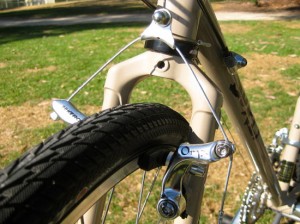
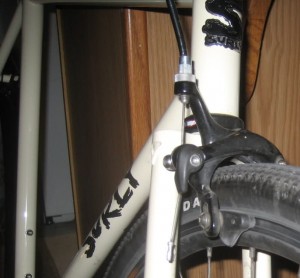
Ancient, totally inadequate caliper and cantilever brake systems
Compare this to, say, a beautiful and strong Magura hydraulic rim break installation:
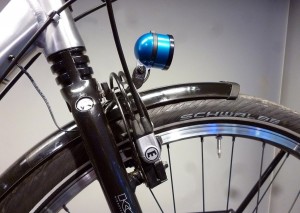
2×10 friction lever gear systems really seem antediluvian in the times of 3×9 (27) or 3×10 (30) indexed derailleur gears, or, even more pertinent to long, hard tours, 14 or 18 inner gear systems. The use of drop-bars and bar-end shifters is an open invitation to an accident, as it means more difficult control with a load, since you have to remove at least one hand from your normal grip position in order to shift. Those levers are also extremely exposed in this location, making them particularly susceptible to damage during the slightest fall, or even if you lean the bicycle against a wall. We have had several customers coming in our workshop with this kind of damage and needing to replace the shift levers.
Compare this with the far more protected “normal” shifter and break lever position on, say, a KOGA bicycle:
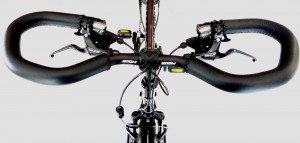
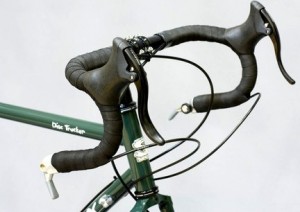
SURLY Bar-end shifters and exposed break levers KOGA LX Shifters and break levers
Or with the even sturdier, more protected and far easier to use Rohloff shifter and Magura hydraulic rim brake lever:
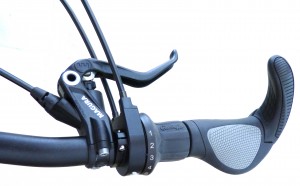
Rohloff shifter and Magura HS 33 hydraulic rim brake lever
Conclusion:
In conclusion, we can only warn against using such a bicycle for serious touring. Light, fast weekend tours, with minimal load or just pedaling on good, paved roads can certainly be nice with it, but on longer tours, this is a recipe for serious discomfort and technical problems, potential accidents and almost certain disappointment. Which are not, as we earlier mentioned, the aims of bicycle touring.
As an afterthought:
There actually is a perfectly usable “Randonneur” bicycle and this is the KOGA Randonneur: Loosely based on the Randonneur idea, it nevertheless sports a very rigid steel frame, with slightly thicker tubes then the ones used on other brands, beautifully connected with lugs. You can really carry a lot of luggage on it, since it is also equipped with sensible, top-quality TUBUS carriers – and even a front kickstand! As for the gear and braking systems: SHIMANO 780 XT touring series throughout guarantee an optimum level of user-friendliness, reliability and long endurance.
Yes, it is a bit higher-priced than other brands – in return it offers a proper riding position for long tours, is agile and very fast and will give you years of trouble-free, thoroughly enjoyable touring cycling under any conditions.
If you are thinking about a Randonneur-style bicycle, this is the one to look out for!
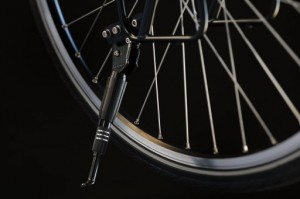

KOGA Randonneur KOGA front kickstand – your bicycle will not fall over even with fully loaded front panniers!
[1]For a thoroughly enjoyable evocation of that era see: Weiss, Eben: BIKE SNOB, Systematically and mercilessly
realigning the world of cycling, Chronicle Books, San Fransisco, 2010, pp.20 – 43.
[2]Rene Hersé, the “Magician of Levalois”, is something of a demi-god in this context.


Leave a Reply
You must be logged in to post a comment.